Insights · Regulation
Anonymisation vs pseudonymisation: what’s the difference?
Pseudonymised data is still personal data; properly anonymised isn't. Here’s how the law tells them apart in the UK, EU and US.
- Published
- Reading time
- 7 min read
- By
- Saskia Russell, Founder's Associate

In this article
Anonymisation and pseudonymisation are often used interchangeably when talking about data security, but their legal definitions are distinct. It’s important to know the difference, because which type your company handles changes the legal consequences. In the UK, properly anonymised data can take you outside UK GDPR, but pseudonymised data usually keeps you inside regulation requirements. Here are answers to four common questions, with UK, EU and US positions flagged where they now differ.
- What’s the difference between anonymisation and pseudonymisation?
- Is anonymised data still personal data?
- What does “data anonymisation” mean?
- What does “pseudonymised data” mean?
There’s an appendix at the end covering US law. Because there is no single federal privacy law, it works differently to the UK and the EU.
What’s the difference between anonymisation and pseudonymisation?
Pseudonymisation swaps a name or other detail for a code or an alternative value, with a key back to the original stored. Anonymisation goes a step further: it changes the data completely and irreversibly so that nobody could reasonably identify anyone. Pseudonymised data still counts as personal data for whoever holds the key, but properly anonymised data doesn’t. Pseudonymisation is reversible for the keyholder, but anonymisation alters data irreversibly.
And futher, pseudonymisation has a legal definition, but anonymisation doesn’t. UK GDPR Article 4 describes pseudonymisation as processing personal data so that it can’t be attributed to a specific person without additional information, as long as that additional information (the mapping back to the original) is kept separately and suitably protected. The link between the two still exists; it just has to be held and protected properly.
Anonymisation has no statutory definition, but it is the route to “anonymous information”, which Recital 26 places outside the law. The Information Commission’s guidance (written in 2025, when it was still the ICO) treats identifiability as a spectrum. Identified individuals sit at one end, and anonymous information at the other. In between, it depends on context.
Pseudonymisation lowers the risk but doesn’t remove it: pseudonymised data is still personal data. Anonymisation leaves you holding less personal data, but data only counts as anonymised when the chance of identifying anyone from it is sufficiently remote.
Is anonymised data still personal data?
No, if the anonymisation has worked. UK GDPR doesn’t apply to anonymous information, but “worked” is judged by the means reasonably likely to be used to identify someone, by whoever holds the data. And anonymising data is itself processing, so you need a lawful basis to do it.
“Means reasonably likely” comes from Recital 26, which weighs the cost and time of identification and the technology available, now and as it develops. Perfect irreversibility isn’t the test.
“Whoever holds it” is the part most explanations skip. The same file can be personal data for you and anonymous for the person you send it to. ICO guidance calls this the “whose hands?” question. The answer depends on what each holder knows and can get access to. In the ICO’s example, a bank and the research institute it shares data with each assess the same dataset from their own position.
Law and guidance are separate. UK GDPR and the Data Protection Act 2018 are law: section 171 of the Act makes it a criminal offence to knowingly or recklessly re-identify de-identified data without the controller’s consent, subject to defences. Regulatory guidance is not a statutory code: it explains how the regulator reads the law and adds good practice.
What does “data anonymisation” mean?
It’s the process of turning personal data into information that no longer relates to an identifiable individual. Typical techniques include removing or generalising fields, aggregating into tables, adding noise and generating synthetic records. In other words, it turns personal data into just information. The guidance recommends checking whether identification is “sufficiently remote”, given who will hold the data.
The result falls outside data protection law. The process doesn’t, so the usual duties apply while it’s being done.
To check anonymisation, the guidance uses the motivated intruder test. Picture a reasonably competent person with access to the internet, libraries and public records who wants to identify someone. Could they?
What does “pseudonymised data” mean?
It’s personal information with the direct identifiers replaced, so records can’t be tied to a person without extra information that’s kept separately and protected. That extra information is the mapping that links each pseudonym to the original. For example, think of a panel ID swapped for a project code, with the lookup table locked away. For whoever holds that table, it’s still personal data.
Pseudonymisation is the right process when you need the same person matched across datasets or records, or when you need row-level detail. It always depends on storing and protecting the key properly. The Data (Use and Access) Act 2025 left this definition, and the definition of personal data (any information relating to an identified or identifiable living individual), unchanged.
In the EU, this may change. The European Commission’s Digital Omnibus proposal of November 2025 would make the personal data definition depend on what each organisation can identify. The Council’s October 2026 position drops that in favour of a new article on pseudonymised data, but nothing has been adopted yet.
Free text needs extra care, since the context or story around it can identify someone even with every name swapped out. Our approach at Nakato, reversible semantic pseudonymisation (RSP), is designed to catch the indirect identifiers that emerge from context. That context is often the richest and most useful material for AI reasoning, so we aim to preserve that relevant context when we generate equivalent “twins”. The mapping to the twins always stays in the customer’s domain, so for the customer the text still counts as personal data.
We choose to pseudonymise rather than anonymise because we aim to preserve data's context. Data remains legally "personal" due to the mapping back to the original that has to be preserved, but also because a twin is produced for each piece of data, tailored to each piece's context. This doesn't mean it can be traced back to the individual behind it. Generating a twin was a choice we made to keep data useable for LLMs. This usefulness was a property that legally anonymised data could not preserve. The detection, twinning, and reversing all gets done for you, on-premises, so that original data never leaves your organisation's domain.
Law and guidance checked 9 November 2026. The Information Commission says its anonymisation guidance is under review after the Data (Use and Access) Act, and its research-specific guidance is still in draft.
Appendix: how US law differs
- There is no single federal privacy law. HIPAA covers health data, the FTC Act covers most businesses, and a growing number of states, led by California and Virginia, have their own laws. The SECURE Data Act (April 2026) would set a federal standard but hasn’t had a committee vote.
- “De-identified” is the term the US uses. De-identified data generally falls outside HIPAA, the CCPA and Virginia-style laws, but each sets its own test. HIPAA’s checklist route, Safe Harbor, removes 18 kinds of identifier.
- Who holds the data still matters. Under the CCPA, data can only count as de-identified if the business holding it takes reasonable measures, publicly commits not to re-identify it, and binds recipients to the same standard. HIPAA’s expert route asks whether the risk is “very small” for the anticipated recipient.
- Pseudonymised data stays personal, with lighter duties. Virginia-model laws switch off access, correction, deletion and portability rights if the key is kept separately under effective controls.
- The FTC polices “anonymous” claims. It says hashing doesn’t make data anonymous, and in 2024 it finalised a $16.5 million order against Avast over browsing data that could be re-identified.
Sources
legislation.gov.uk
Anonymous information is outside the law; the 'means reasonably likely' test.
Data Protection Act 2018, section 3
UK Parliament
Definition of personal data, unchanged by the Data (Use and Access) Act 2025.
Data Protection Act 2018, section 171
UK Parliament
The offence of re-identifying de-identified personal data without the controller's consent.
Information Commissioner's Office, 28 March 2025
Identifiability as a spectrum.
Information Commissioner's Office, 28 March 2025
The guidance is not a statutory code and is under review after the Data (Use and Access) Act.
Information Commissioner's Office, 28 March 2025
Anonymising personal data is itself processing and needs a lawful basis.
How do we ensure anonymisation is effective?
Information Commissioner's Office, 28 March 2025
'Sufficiently remote', the 'whose hands?' question and the motivated intruder test.
Information Commissioner's Office, 28 March 2025
Pseudonymised data is personal data for whoever holds the additional information.
Consultation on draft guidance about anonymisation and pseudonymisation for research
Information Commission, 24 August 2026
The research-specific guidance is still in draft.
EU Digital Omnibus: European Council adopts its position
Addleshaw Goddard, 2026
The Commission's proposal and the Council's October 2026 position.
45 CFR 164.514, other requirements relating to uses and disclosures of protected health information
eCFR
HIPAA de-identification: Safe Harbor and expert determination.
California Civil Code section 1798.140
California Legislature
CCPA definitions of deidentified and pseudonymised information.
Code of Virginia section 59.1-581
Virginia General Assembly
Processing de-identified and pseudonymous data.
No, hashing still doesn't make your data anonymous
Federal Trade Commission, 24 July 2024
Hashing does not make data anonymous.
Federal Trade Commission, 27 June 2024
The $16.5 million Avast order.
Written by
Saskia Russell
Founder's Associate
Saskia Russell is Founder's Associate at Nakato. She writes about how organisations can use sensitive customer data with AI models: what the law says, how the methods compare, and what is required to get a project moving.
More insights

Regulation ·
What should a customer-data AI release checklist include?
A fill-in checklist for approving AI that uses customer data: five sections, each with a question, the evidence to attach and a red flag.
8 min read
Regulation ·
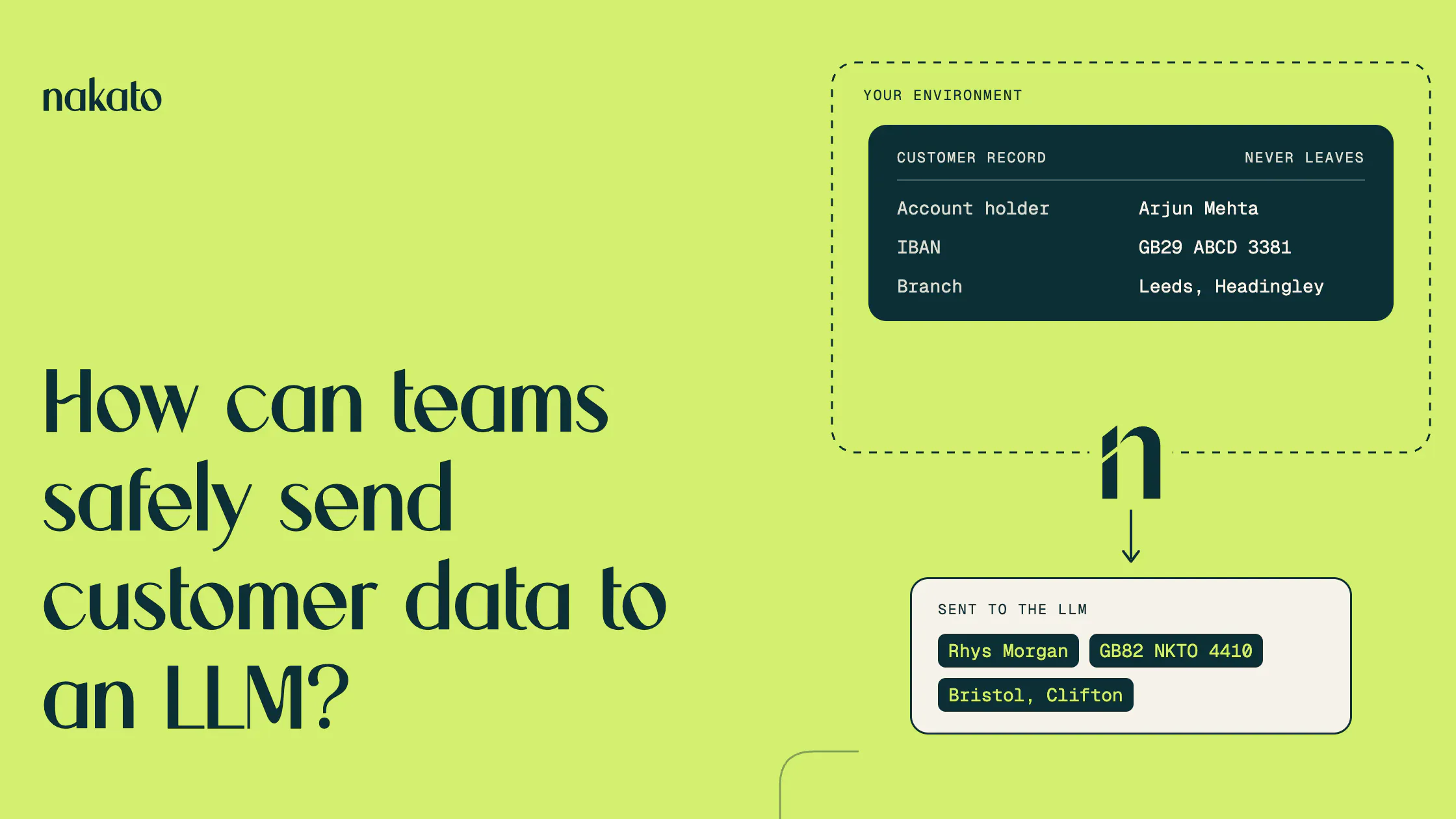
How can teams safely send customer data to an LLM?
Approve one task and one data flow, keep the key that reverses the twins in your own environment, and test the detector on your own text.
9 min read
Regulation ·
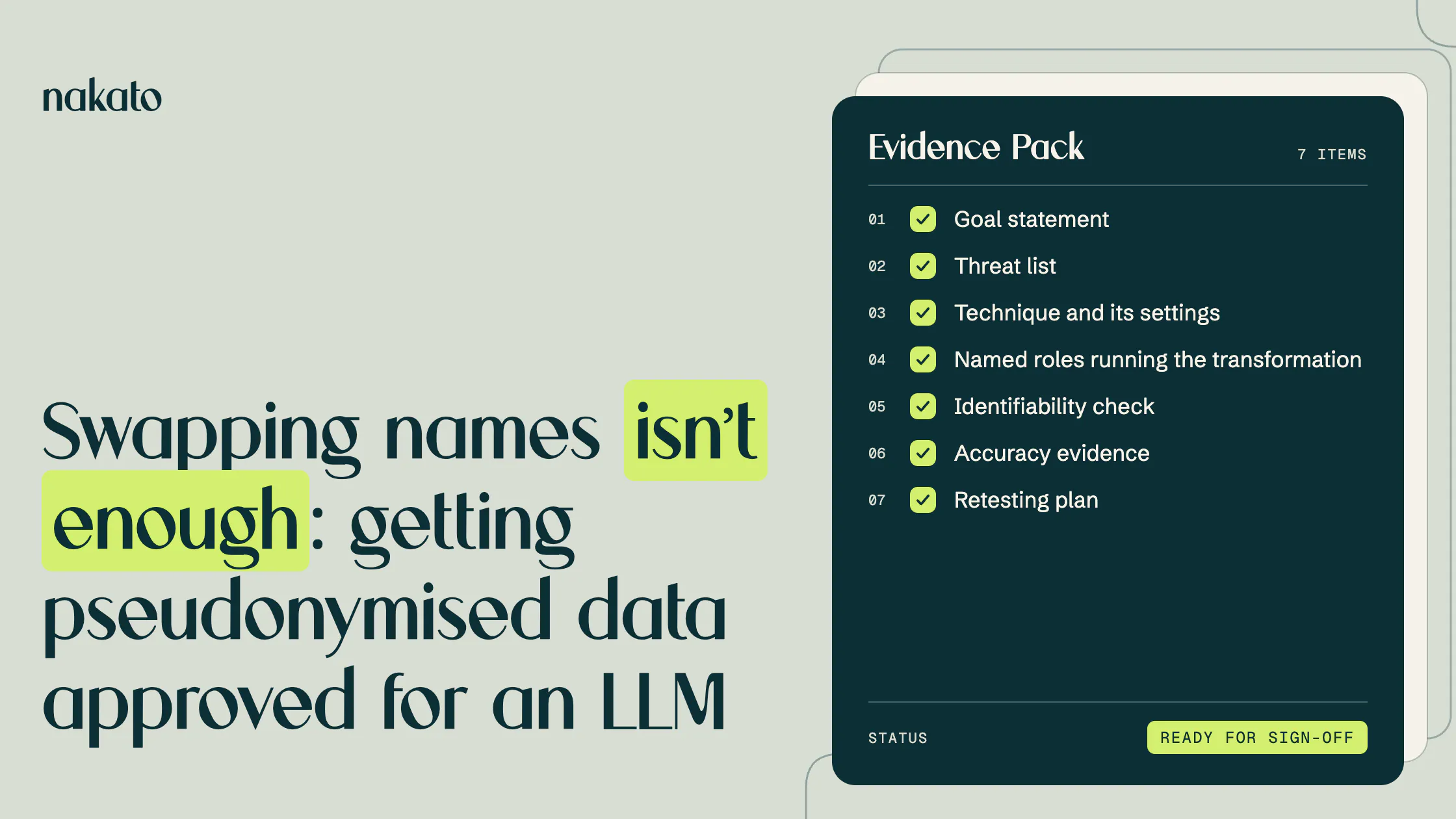
Swapping names isn’t enough: getting pseudonymised data approved for an LLM
Pseudonymised data stays personal data while you hold the key. A committee approving it for an LLM needs written evidence on seven points.
6 min read