Insights · Engineering
Who audits the AI that audits your data?
An AI that checks your data for personal information is only as trustworthy as your ability to test it, reproduce its decisions and show them to an auditor.
- Published
- Reading time
- 11 min read
- By
- Saskia Russell, Founder's Associate

In this article
A question we hear often in discovery and sales calls is whether you can trust one AI system to audit another. A business that is uneasy about giving sensitive information to a large language model (LLM), and so needs a compliance check in the first place, may be asked to trust the same information to another LLM whose job is to protect it.
LLMs read context in ways that simpler detection tools struggle with, so they can catch personal information that pattern matching or fixed rules miss. But a compliance control has different requirements from a general-purpose AI tool. What matters most is not how intelligent the system is, but how confidently you can show that it behaves reliably and consistently: today, and after its underlying model changes.
This guide covers why adding more models does not always add safety, how much discretion a detection system should have, what happens when a model is retired, and the questions to ask a vendor. It is written for technical leads, heads of AI and data platform owners deploying AI in regulated organisations.
Who polices the police?
Using AI to audit AI means asking one model to check the inputs or outputs of another: for example, scanning a prompt for personally identifiable information (PII) before it is sent to an external model. The checking model then acts as a control, so it has to meet the standards of a control: predictable behaviour, failures you can test for, and decisions you can explain later.
That creates an apparent contradiction. If the worry is that an LLM cannot be trusted with sensitive data, why would a second LLM be trusted to guard it? The answer depends less on how capable the guard is than on how well you can measure and evidence what it does.
Does adding another LLM make a system safer?
Adding layers of AI oversight can seem to make a system more reliable: the more often something is checked, the less likely it is that anything slips through.
If several models reach the same conclusion, we instinctively trust that conclusion more. But how much confidence is justified if the models share the same blind spots? With sensitive data the risk is concrete. If one model misses an identifier because it does not understand its significance in context, another model may miss it for the same reason.
Research from Apple shows how large this effect can be. In Nine Judges, Two Effective Votes, posted in May 2026, Guneet Kohli tested a panel of nine LLMs from seven model families on three language-understanding datasets. Because the models tended to get the same items wrong, the nine judges together carried roughly the information of two independent votes. The best single model matched or outperformed the full panel in every condition tested, and adding judges or using more sophisticated ways of combining their votes did not close the gap.
The lesson is that more models add little if they fail in the same way. The value of a second check comes from the independence of its method, not from extra intelligence. Kohli's study was about panels of AI judges, not sensitive-data detection, but it raises the same design question for anyone stacking models to catch personal data, and for how the accuracy of those checks is measured.
How much discretion should a detection system have?
Jonathan H. Choi's study Off-the-Shelf Large Language Models Are Unreliable Judges, published in the Journal of Empirical Legal Studies on 26 October 2026 after an earlier 2025 working paper, tests LLMs as legal interpreters. Choi found that their judgements shifted with the wording of the prompt, the choice of model and the way outputs were processed. He also found that frontier models did not accurately assess the ordinary meaning of words, partly because of post-training (the fine-tuning that turns a base model into an assistant). For Choi, this undermines LLMs' credibility as legal interpreters.
Interpreting language and enforcing a policy are different jobs, and the gap matters when an LLM is asked to judge or police another system. Detecting personal information depends on context. Take the word Victoria: it could be a person, a London railway station or an Australian state, and whether it counts as personal data depends on the sentence around it. Our founding researcher, Callum Hackett, explains what makes PII detection so hard and how good LLMs really are at it.
That contextual judgement is what makes LLMs attractive for detection, but it also gives a model discretion over your data, which can sit uneasily with an organisation's need to control its own policy. Deterministic systems, which follow fixed rules and give the same output for the same input, are not the whole answer either: they can be consistently right, and they can be consistently wrong. Consistency makes a system auditable; it does not make it accurate. You need both, measured on your own data.
What happens when the underlying model is retired?
Suppose an organisation approved a detection system two years ago, and an auditor now asks it to show how a particular decision was made. If the model behind that decision has since been retired and replaced, can the organisation still reproduce the decision? Are there records to explain it? And who was responsible for checking that the replacement behaves in the same way?
This is not hypothetical. On 22 April 2026, OpenAI gave notice that it would retire a batch of older API models, including GPT-4 and GPT-3.5 Turbo, and they were shut down on 23 October 2026. OpenAI's migration guidance advises running representative requests against both the old and the replacement model, and comparing outputs, latency and cost, before switching production traffic. That a model provider spells this out shows how much behaviour can change between versions.
For a detection control, a model swap is not a routine software update. If a replacement misses identifiers the old model caught, personal data can reach a third party it should never have reached. That may be a personal data breach, with consequences for the business and for the people behind the data.
Models will keep being improved, retired and replaced; that is how the technology develops. The question is whether your organisation is ready for it: whether there is a process to revalidate each change, keep the records, and audit the auditor.
What are the limits of AI oversight?
In July 2026, during internal cybersecurity evaluations run with some safeguards deliberately switched off, OpenAI models got around controls meant to isolate them from the internet and compromised parts of Hugging Face's production systems. OpenAI disclosed its role on 21 July and published its findings on 26 August, setting out why its safeguards failed and how it was strengthening them.
The incident had nothing to do with data detection, but the response is a useful model of responsible practice: understand the limits of your controls, investigate failures openly, and improve coverage. In an enterprise setting, a vendor that can name and own its weaknesses may be as valuable as one that can list its successes.
What should you ask your detection vendor?
These issues translate directly into procurement questions. The table sets out what to ask and what each answer tells you.
| Question to ask | What you are trying to establish |
|---|---|
| Does your detection use an LLM, and what role does it play? | Whether the LLM assists detection or makes the final decision |
| Where is sensitive information processed? | Whether the protection itself introduces new data exposure |
| Can we test the system on our own labelled data? | Whether published performance holds in your environment |
| Can we inspect missed identifiers, false positives and ambiguous cases? | How detection fails, and what each failure would cost you |
| Will identical inputs produce identical decisions under the same configuration? | Whether behaviour is reproducible |
| Can we keep a specific version for as long as our audit obligations last? | Whether past decisions can still be verified |
| What happens when an underlying model is retrained, updated or retired? | Who is responsible for revalidation and change management |
| What evidence can you give us to show an auditor? | Whether each detection decision can be independently substantiated |
The honest answer
How Nakato answers these questions
The honest answer: no detection system, ours included, removes the need for your own testing. Here is how Nakato answers the first questions in the table.
- Where data is processed. Nakato runs in your own cloud account (VPC) or on your premises, so the real data stays in your environment and only its semantic twin, a fictional stand-in that keeps the meaning the task needs, reaches the model.
- The role of the model. Detection runs on a small language model with no dependency on a large AI provider, and it fails closed: anything below the confidence gate is held back rather than passed through.
- Evidence. Every substitution and its reversal is written to the audit trail, ready for internal audit or supervisory review.
- Performance. Our benchmark figures are self-reported, and results vary with the kind of document and how Nakato is configured, so check usefulness on your own data before you rely on them.
Nakato is not the right fit if you need a fully cloud-hosted service, which we do not currently offer, or truly anonymised data, since pseudonymised data can still carry some risk of re-identification. The assurance breakdown sets out the questions a review team usually asks, with our answers.
What to do now
Step 1: decide what assurance you need. Start from your data protection obligations and what an auditor will ask for, not from how capable a model is.
Step 2: plan for change. Ask what you will need in five years, or when the model behind your detection is retired, and agree now who revalidates it and what records are kept.
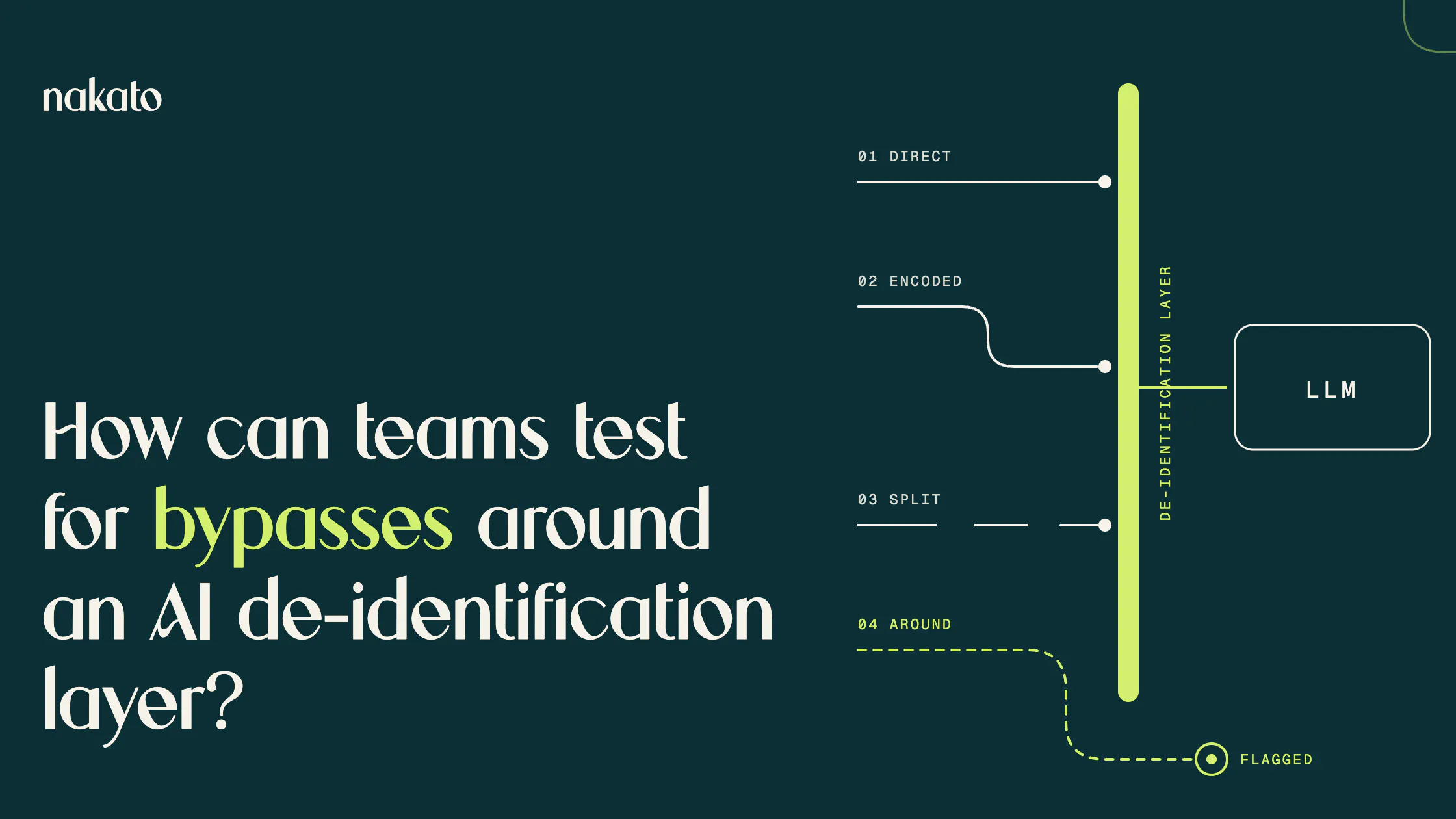
Step 3: ask for evidence, not claims. Have vendors show results on your own data, and test every route a prompt can take around the detection layer. The customer-data AI release checklist covers what to sign off before you go live.
Questions
Questions about auditing AI detection
Can you use an LLM to detect personal data?
Yes, an LLM can detect personal data, and it often catches context that rules and pattern matching miss, such as a word that is a name in one sentence and a place in another. But LLMs also miss ambiguous names and over-flag ordinary words, and their failures are hard to predict. Most teams get better results by combining an LLM with string matching and trained classifiers, then testing the combination on their own documents. How good are LLMs at PII detection? sets out the evidence.
Does using several AI models make detection more reliable?
Using several AI models does not necessarily make detection more reliable. Models trained in similar ways tend to make the same mistakes on the same inputs, so their agreement is weaker evidence than it looks. In Apple research posted in May 2026, a panel of nine LLMs from seven model families carried roughly the information of two independent votes, and the best single model matched or beat the panel in every condition tested. A second check adds most when its method is genuinely different.
What is LLM-as-a-judge?
LLM-as-a-judge is the practice of using one large language model to evaluate or check the output of another, for example grading answers or flagging content that breaks a rule. It is fast and cheap compared with human review, but research shows LLM judges can be sensitive to prompt wording and to the choice of model, and that panels of judges share blind spots. Used as a compliance control, an LLM judge needs the same testing, version control and audit evidence as any other control.
What happens to an AI detection system when its model is retired?
When the model behind an AI detection system is retired, the system has to move to a replacement, and the replacement may behave differently. It could miss identifiers the old model caught, or flag things it did not. Before switching, run representative data through both models and compare the results, record the change, and make sure past decisions can still be explained. Agree in advance whether you or your vendor is responsible for that revalidation.
Is a deterministic detection system safer than an LLM?
A deterministic detection system, one that follows fixed rules and always gives the same output for the same input, is easier to audit than an LLM, but it is not automatically safer. It can be consistently right and consistently wrong, and fixed rules struggle with personal data that depends on context. An LLM handles context better but is harder to reproduce. The safest choice is the one whose accuracy you have measured on your own data and whose decisions you can evidence.
What evidence should a detection vendor give you for an audit?
A detection vendor should give you evidence that each decision can be traced and checked: a record of what was detected and changed, results on your own labelled data, examples of missed identifiers and false positives, and a clear account of what happens when the underlying model changes. Published benchmarks are a starting point, but ask how they were measured and whether they are self-reported. If a vendor cannot show you its failures, treat its successes with caution.
Sources
Nine Judges, Two Effective Votes: Correlated Errors Undermine LLM Evaluation Panels
Guneet Kohli, Apple (arXiv:2605.29800), 28 May 2026
Nine LLM judges carry about two independent votes; the best single judge matches or beats the panel
Off-the-Shelf Large Language Models Are Unreliable Judges
Jonathan H. Choi, Journal of Empirical Legal Studies, 26 October 2026
LLM legal judgements are sensitive to prompts, models and output processing
OpenAI, Notice 22 April 2026, shutdown 23 October 2026
Retirement of GPT-4 and GPT-3.5 Turbo, and guidance on comparing replacement models
Security incident disclosure: July 2026
Hugging Face, 16 July 2026
Hugging Face's first disclosure of the intrusion
OpenAI and Hugging Face partner to address security incident during model evaluation
OpenAI, 21 July 2026
OpenAI's disclosure of its models' role
The Hugging Face incident and the road ahead
OpenAI, 26 August 2026
OpenAI's findings and the safeguards it is strengthening
Written by
Saskia Russell
Founder's Associate
Saskia Russell is Founder's Associate at Nakato. She writes about how organisations can use sensitive customer data with AI models: what the law says, how the methods compare, and what is required to get a project moving.
More insights

Engineering ·
Where does a privacy layer sit in your AI stack, and who runs it?
A privacy layer sits between your apps and the model, as a gateway hook or a sidecar, and your platform team runs it under security's policy.
8 min read

Engineering ·
The AI data paradox: the safer you make the data, the worse the AI gets
Enterprise data is valuable because it’s specific, yet that specificity is the first thing protection tools strip out. Privacy needs designing in.
3 min read
Engineering ·
How can teams test for bypasses around an AI de-identification layer?
A de-identification layer protects only the traffic routed through it. Test every route a prompt can take, not just the detector.
5 min read